Guy Kawasaki's 10/20/30 rule is probably the most widely used pitch deck template in the startup world. Ten slides. Twenty minutes. Thirty-point font. Simple, memorable, and — for most founders — the starting point for every investor conversation.
But here's what most founders don't realise: each of those ten slides is trying to prove something specific to the investor. And most pitch decks fail not because the information is wrong, but because it's disconnected. Slide 4 makes a claim that slide 7 should support and slide 8 should reinforce — but nobody connects the dots.
We mapped each of Kawasaki's ten slides to the evidence dimensions that actually determine whether an investor says yes.
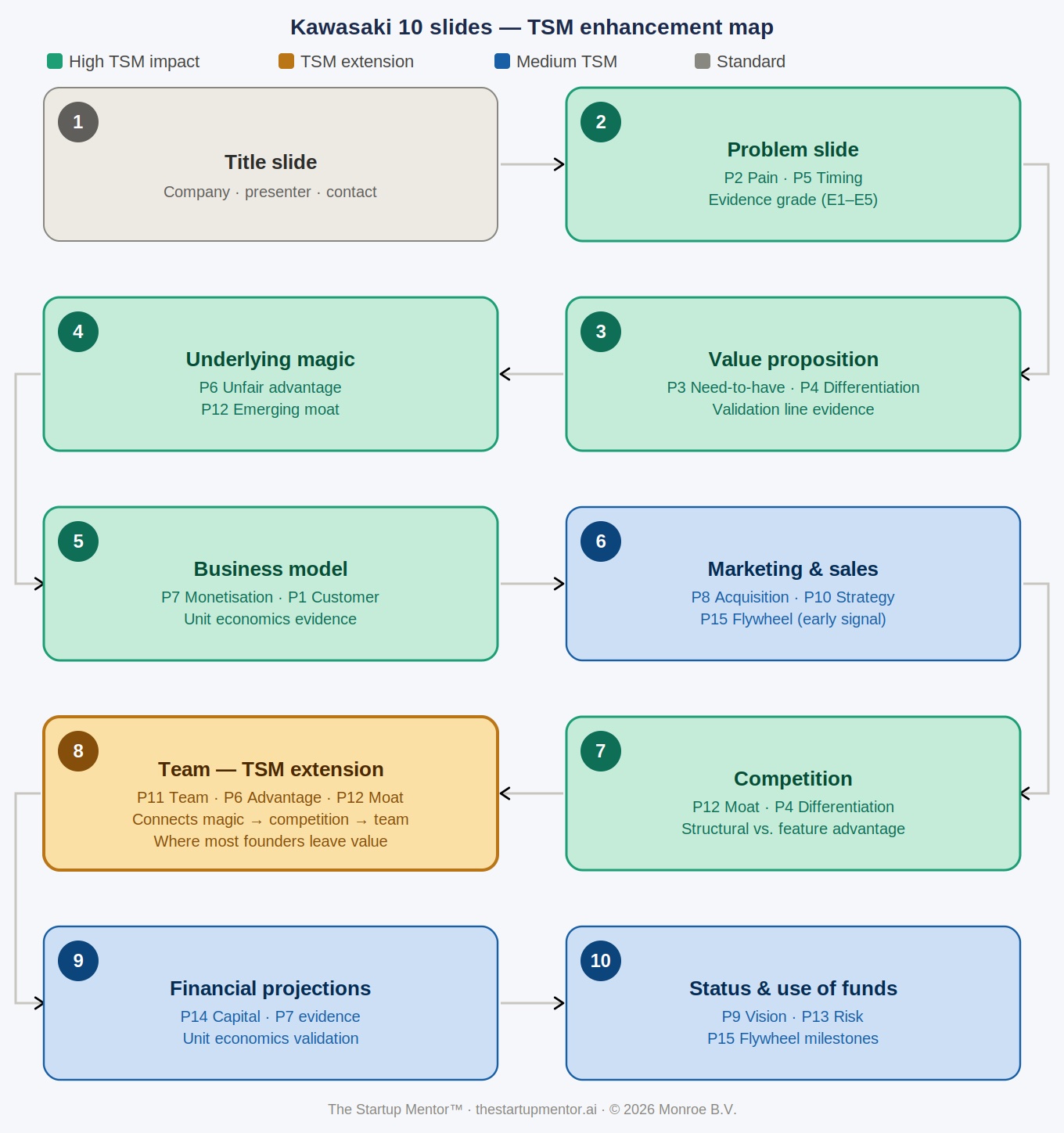
What the colour coding reveals
The green slides are where a structured assessment adds the most value. Not because the founder can't write those slides — but because the claims on those slides need evidence grading. When your problem slide says "this is a massive pain point," the question is not whether the slide looks good. The question is whether the pain is independently verifiable (E3), backed by customer data (E4), or something you believe because you experienced it once (E1). Those are very different levels of evidence, and they produce very different investor responses.
The blue slides — competition and marketing — are where medium-depth assessment matters. A competition slide that lists four competitors in a 2×2 matrix is standard. A competition slide that explains your structural advantage over each and maps it to a defensible moat is a fundamentally different conversation.
The amber slide: where most founders leave value on the table
Slide 8 is the team slide. In Kawasaki's template it's straightforward: names, roles, backgrounds. Most founders treat it as a credential list. But the team slide is where three other slides should converge. Your underlying magic (slide 4) should connect to your competitive positioning (slide 7) should connect to why this specific team can execute on both. That thread — magic to competition to team — is the strongest story in any pitch deck. And almost nobody tells it.
This is what an assessment does that a pitch deck template cannot. It does not ask you to fill in ten slides. It assesses all sixteen dimensions simultaneously, identifies where the evidence is strong, where it is weak, and — critically — where the connections between dimensions are missing. The team-moat-advantage connection is one of the most common gaps we find. It is also one of the most valuable to close.
What's missing from the template entirely
Kawasaki's ten slides cover a lot of ground. But they also leave some dimensions out. There is no slide for operational readiness — whether you can actually deliver what you are promising. There is no slide for evidence velocity — whether you are generating new validation faster than you are burning cash. There is no slide for risk awareness — whether you know what could kill your company and have a plan for it.
These are not obscure dimensions. They are things every experienced investor evaluates, whether they have a slide for it or not. The difference is that without a structured framework, they evaluate them through gut feel. With one, they evaluate them through evidence.
The pitch deck is the introduction. The assessment is the evidence.
This is not an argument against Kawasaki's template. It is an excellent structure for telling a story in twenty minutes. But a story is not evidence. A pitch deck is designed to persuade. An assessment is designed to verify. The best founders use both — the deck to open the door, the assessment to close it.
An investor who receives a Kawasaki-format pitch alongside a sixteen-dimension, evidence-graded assessment is not just better informed. They can see exactly where the founder's claims are supported and where they rest on assumptions. That transparency is what converts a pitch meeting into a term sheet discussion.
"A polished pitch deck proves someone knows how to polish a pitch deck. An assessment proves the business behind it."