A partner asks "how did you get to that number?" and the room goes quiet.
That is the problem with every AI valuation tool on the market right now. They are calculators. Sophisticated ones — running Berkus, Scorecard, DCF, Revenue Multiples in parallel. Some claim seven methods simultaneously. Impressive engineering. But they all share the same fatal flaw: the founder fills in the inputs.
The input problem
"What's your revenue growth?" The founder types a number. The tool believes it. Runs seven methods on it. Produces a PDF with a valuation range that looks precise and means nothing. Garbage in, garbage out — just with better formatting.
This is not a criticism of the founders. They are answering honestly — or at least as honestly as conviction allows. They believe their revenue will grow at 40%. They believe their market is worth $2 billion. They believe their churn rate will drop next quarter. Belief is not dishonesty. But belief is also not evidence. And the valuation is only as good as the evidence behind it.
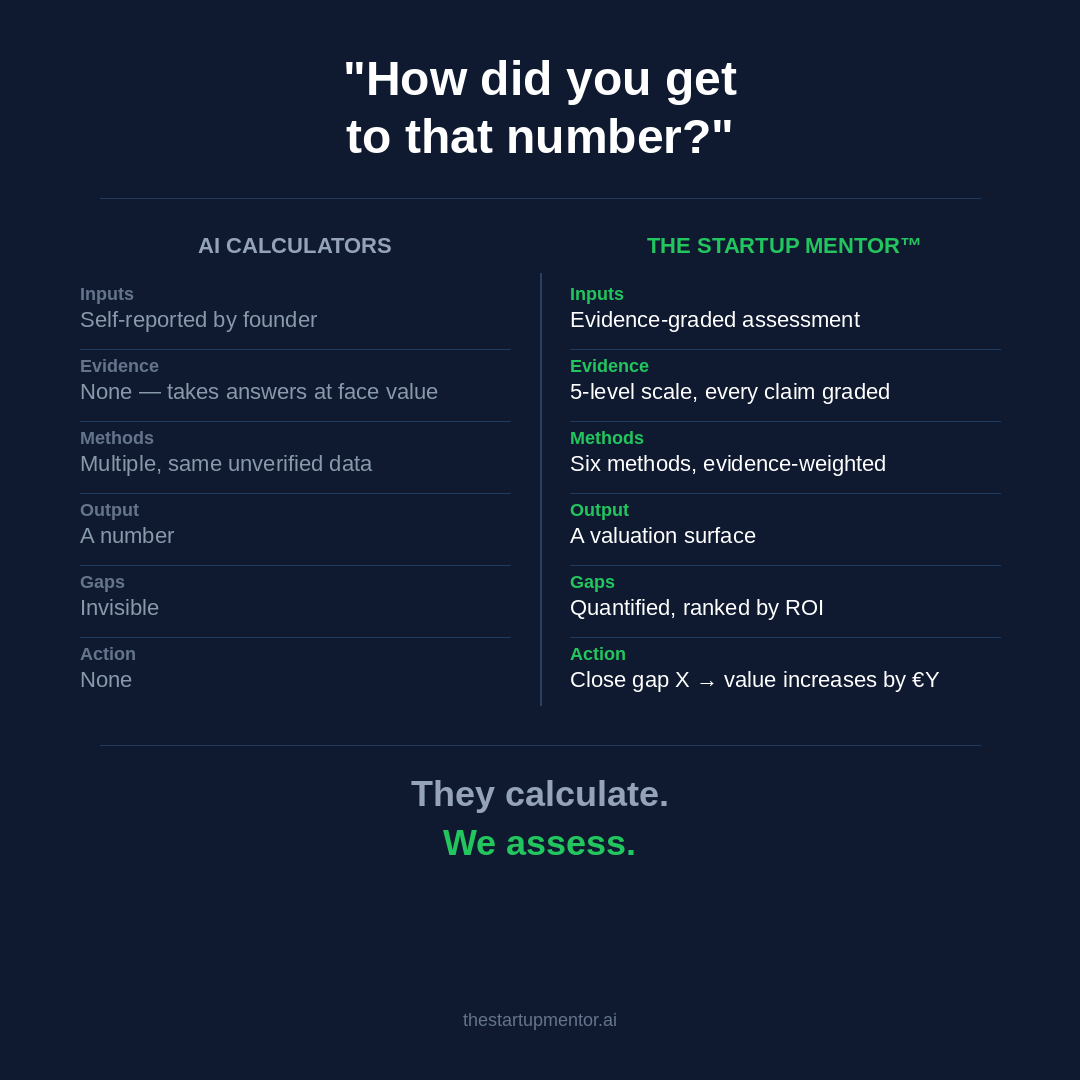
What evidence-graded valuation looks like
At The Startup Mentor™ we built a system that does not ask the founder what their revenue growth is. It assesses it. Sixteen dimensions. Five evidence levels. Every claim graded against observable data — not self-reported conviction.
A value dimension scoring 90% with no evidence behind it is worth almost nothing. The same dimension backed by customer contracts and transaction data is worth 17 times more. The founder cannot bluff by filling in a form optimistically. The evidence multiplier catches it.
The valuation engine then runs six established methods — Berkus, Scorecard, Risk Factor Summation, First Chicago, Venture Capital Method, Cost-to-Duplicate — but each one is fed with evidence-graded inputs, not self-reported ones. Every method is weighted by stage relevance. Every weight is disclosed. It is not a black box.
The evidence gap waterfall
This is the feature that changes the conversation entirely. A calculator tells you what you are worth. An assessment tells you what is holding your value down — and what would change it.
Consider a startup where the monetisation dimension scores well on conviction but sits at E1 on evidence — the founder has a pricing model but no paying customers. The evidence multiplier on E1 is close to zero, so that dimension contributes almost nothing to the valuation, regardless of how well-designed the pricing model is. If the founder completes five customer conversations and converts one to a paying contract, that dimension moves from E1 to E3. The evidence multiplier increases from 0.05 to 0.55 — an eleven-fold increase. The valuation range moves up by a specific, quantifiable amount.
That is not a theoretical example. It is a calculation the system produces for every assessment, for every dimension, for every startup. The founder walks away not with a number but with a ranked list of the most valuable things they can do next.
What the legal system already knows
The difference between these two approaches is not technical. It is fundamental. It lies at the heart of our entire legal system.
When a judge sentences someone, she is placing a valuation on the severity of the crime — this crime is worth so many years in jail. She does it not on the basis of what people believe, but on the basis of what the evidence shows. In fact, the whole purpose of a trial is to tease out the difference between what people believe happened and what the evidence can demonstrate.
The word "conviction" means two things. A deep personal belief — "I have the conviction that this is true." And a verdict reached through evidence — "the jury returned a conviction." Same Latin root: convincere, to overcome by proof.
In the courtroom, a conviction is what happens when belief survives contact with evidence. The prosecutor believes the defendant is guilty. The trial tests whether that belief holds up under scrutiny, under cross-examination, under the weight of observable facts.
"Calculators measure conviction as belief. We test whether conviction survives the evidence. Same word. Very different valuation."
What this means for founders
If you are raising capital, you have conviction. You would not be doing this if you did not believe in what you are building. That conviction is necessary. But it is not sufficient.
An investor sitting across the table from you is trying to determine one thing: how much of your conviction is supported by evidence, and how much rests on assumptions that have not yet been tested? A calculator cannot help them answer that question because it never asked it in the first place. It took your conviction at face value and ran the numbers.
An evidence-graded assessment asks the question directly. And the answer — the gap between conviction and evidence, dimension by dimension — is the most valuable thing a founder can know before they walk into an investor meeting.
Because closing that gap before the meeting is not just good preparation. It is where the value is created.