Every startup framework starts with the same question: "What stage are you at?" Ideation. Validation. Traction. Product-market fit. Scaling. It sounds logical. It is also the wrong question.
The stage tells you where the startup is. It says nothing about what investment decision the evidence supports. A startup at traction can be seed-ready, Series A-ready, or not ready for anything — depending entirely on what they can prove.
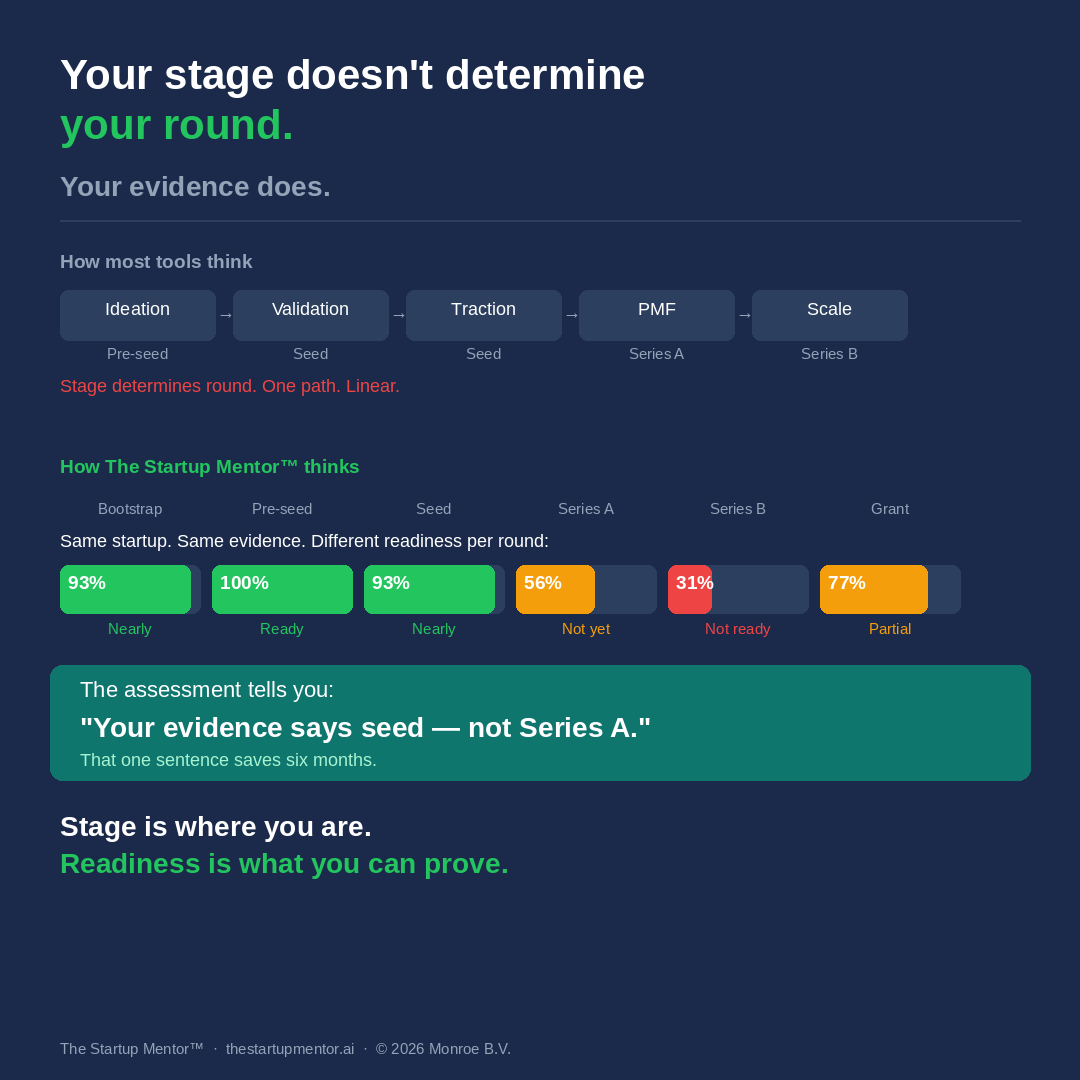
The linear assumption
Most tools and frameworks treat stages as a linear path. Ideation leads to pre-seed. Validation leads to seed. Traction leads to Series A. As if the business stage automatically determines which round you should raise.
This creates two problems. Founders target the wrong round — burning months preparing for a Series A when their evidence supports a seed. And investors miscategorise deal flow — passing on a startup because it "looks early" when the evidence base is stronger than companies raising at the same level.
The stage label is a description. It is not a prescription.
What investment readiness actually means
At TSM™ we built an assessment that does not start with stage. It evaluates all sixteen value growth dimensions regardless of where the startup sits. Then it runs the evidence against six different investment readiness profiles — bootstrap, pre-seed, seed, Series A, Series B, and grant — each with its own evidence thresholds per dimension.
Every round has a different bar. Pre-seed needs a credible team and a validated problem. Seed needs a product in use and early traction signals. Series A needs repeatable revenue, proven unit economics, and a go-to-market that works. Grant needs societal impact framing, consortium capability, and regulatory alignment. Bootstrap needs revenue from day one and capital efficiency above everything else.
The same startup, with the same evidence, produces a different readiness score against each of these profiles. That is the point. Readiness is not a single number. It is a spectrum across round types.
The gap is the action plan
The most valuable thing this assessment surfaces is not the readiness score. It is the gap between the round the founder is targeting and the round the evidence supports.
Most founders aim too high too early. They hear "you should raise a Series A" from an advisor who looked at the product and the team but did not look at the evidence base. They spend six months preparing for a round that requires evidence levels they are twelve months away from reaching. Meanwhile, the seed round they could close next month — the one their evidence actually supports — goes unraised.
That single finding — "your evidence says seed, not Series A" — saves six months and redirects effort toward the raise that will actually succeed.
Bootstrap is not a consolation prize
One of the things we discovered building this system is that bootstrap does not belong on the same ladder as pre-seed through Series B. It is a parallel choice, not a step below pre-seed. A bootstrapping founder is both the founder and the investor. Their evidence requirements are different in kind, not just in degree — revenue velocity matters from day one, pitch narrative does not matter at all, and the fundamental question is not "will an investor fund this?" but "should I keep investing my own time?"
Treating bootstrap as a first-class investment path rather than a default for founders who "haven't raised yet" changes what the assessment recommends. A bootstrapper does not need to build toward Series A readiness. They need to build toward sustainable revenue. The milestone sequence is different. The evidence thresholds are different. The kill criteria are different.
Grant readiness is a different axis entirely
Grant funding — Horizon Europe, EIC Accelerator, national innovation programmes — evaluates on a different axis from equity. The evidence that makes a startup Series A-ready (repeatable revenue, proven unit economics) is almost irrelevant for a grant application. What matters instead is societal impact, innovation beyond the state of the art, consortium capability, and alignment with policy priorities.
A startup can be grant-ready and not seed-ready, or seed-ready and not grant-ready. These are independent assessments that happen to be applied to the same company. Running both in parallel gives the founder a complete picture of their funding options — not just the equity path they assumed was the only one.
Stage is an input. Readiness is the output.
The assessment still evaluates stage. It needs to know whether a company is pre-product or post-revenue in order to calibrate which dimensions are active and what evidence levels are expected. But the stage is an input to the analysis, not the conclusion.
The conclusion is: given your current evidence, which rounds can you credibly pursue, what specific gaps stand between you and each one, and what is the most efficient path from where you are to where you want to be?
That turns a stage label into an action plan. And it turns a fundraising strategy from "I think I should raise a Series A because my advisor said so" into "the evidence supports seed at 93%, and here are the three things I need to prove before Series A becomes viable."
"The gap between the round you're targeting and the round your evidence supports is the single most valuable thing an assessment can surface."